

Digital platforms now carry registers, resources, presentations, assessments and communication. Most days, that makes schoolwork faster. When connectivity fails, a service becomes unavailable or a classroom device will not cooperate, the dependence becomes clear very quickly.
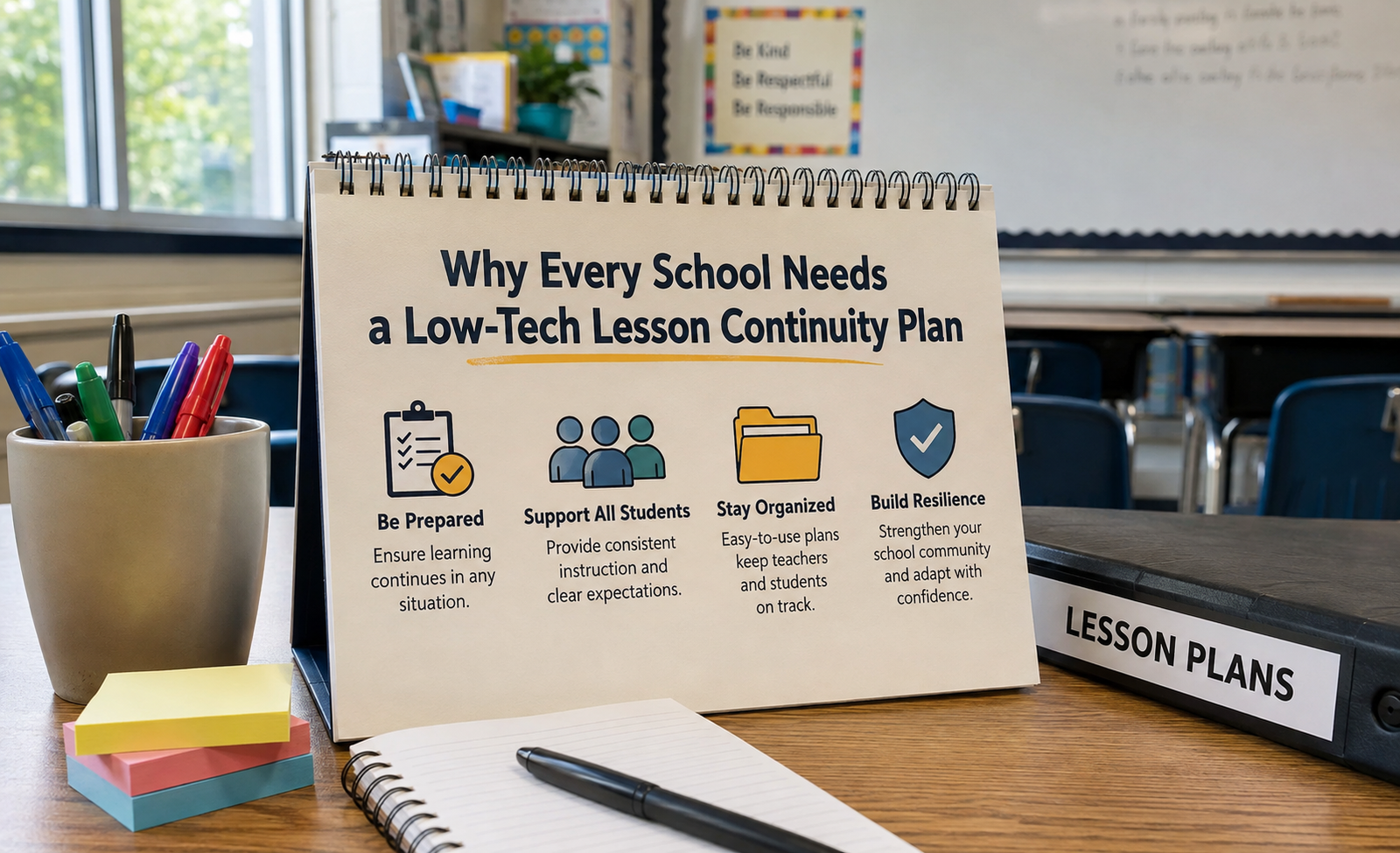
A low-tech continuity plan does not reject digital education. It identifies the few physical resources and routines needed to keep teaching purposeful during a disruption. The aim is not to recreate every online function. It is to protect the core lesson while technical staff address the problem.
Schools already plan for fire, severe weather and other operational risks. A short plan for classroom technology failure deserves the same practical treatment, especially when several subjects rely on cloud-based material.
Continuity starts with the learning objective
Emergency activities often fail because they are generic time-fillers. A better plan begins with what pupils were meant to learn. Teachers can then prepare a paper or discussion route that addresses the same objective at a simpler level.
For example, if pupils were due to analyse data online, the backup pack could contain one printed dataset and questions that test the intended skill. If a class was going to collaborate in a shared document, groups could organise ideas on paper and appoint someone to enter the final version later. If a video formed part of an explanation, the teacher might use still images, a diagram and targeted questions.
Not every lesson needs a complete duplicate. Departments can identify high-dependence units and produce a small number of adaptable resources. These should be reviewed when schemes of work change, otherwise the backup folder will quickly become irrelevant.
A flipchart pad provides a shared offline workspace
A flipchart pad can replace several digital functions during a short outage. It can display the lesson sequence, collect questions, hold group findings and preserve a summary for later transfer. Unlike individual worksheets, it gives the class a shared point of reference.
Plain pages work well for concept maps, diagrams and sorting ideas into clusters. Lined pages can support ordered explanations or action lists, while gridded formats are useful for simple graphs and layouts. InClassTomorrow stocks flipchart pads alongside wider school and teacher supplies, allowing continuity materials to be included in normal procurement rather than treated as specialist emergency equipment.
The pad should be stored with working markers and a stand or suitable display method. A resource that cannot be found or used safely during an outage is not part of a real plan. Departments can label a small continuity kit and check it at the start of each term.
Plan group work that does not depend on logins
Many digital lessons use technology to distribute information and collect responses. Offline group structures can perform those jobs with different materials. Each group might receive a source pack, assign roles and record one agreed response on a large sheet. The sheets can then be displayed for a gallery review, with pupils adding questions on notes or in their books.
This approach needs clear instructions. The teacher should state the output, time available and standard for completion. Roles such as reader, recorder and checker can help, but they should rotate so that the same pupil is not always responsible for writing.
Large paper also makes misconceptions public enough to address. A teacher can compare two approaches with the class and ask which evidence supports each one. When systems return, the photographed or transcribed outcomes can be added to the normal digital record if needed.
Include accessibility in the backup design
A paper alternative is not automatically accessible. Font size, contrast, reading load and physical positioning all matter. Pupils who use assistive technology may need a specific contingency rather than the standard printed pack. Schools should involve the SEND coordinator and relevant pupils when planning.
Large sheets can be positioned where pupils can approach them safely, or placed flat on tables for seated work. Instructions should also be read aloud and broken into manageable stages. If coloured markers are used, meaning should not depend on colour alone.
The plan should preserve reasonable adjustments wherever possible. A temporary technical problem does not remove the school’s responsibility to support access. Knowing the likely barriers in advance is much better than improvising while the class waits.
