


Imagine walking into one of the grandest museums on earth, only to find its most treasured masterpiece gone — just an empty space on the wall where the world’s most famous smile used to be. That’s exactly what happened during the infamous Louvre robbery of 1911. On a quiet Monday morning in August, Leonardo da Vinci’s Mona Lisa disappeared from the Louvre Museum in Paris, sparking global outrage, wild theories, and a manhunt that gripped nations. This wasn’t some high-tech Ocean’s Eleven-style operation with lasers and gadgets; it was astonishingly simple, yet it changed art history forever.
In this detailed exploration of the Louvre robbery, we’ll uncover exactly what happened that day, reveal the surprising man behind it, explain what was stolen (and why it mattered so much), and examine the lasting consequences. From mistaken motives to celebrity suspects, the full story is far more fascinating than fiction.
The Louvre Museum in Paris stands today as a symbol of cultural grandeur, with its iconic glass pyramid greeting millions of visitors each year.
The Louvre: From Royal Palace to World-Famous Museum
The Louvre has a rich history that sets the stage for understanding why the 1911 theft was such a scandal. Originally built as a fortress in the 12th century, it evolved into a lavish royal palace for French kings. By the time of the French Revolution in 1793, it was transformed into a public museum to showcase the nation’s artistic treasures. Over the centuries, the Louvre’s collection grew immensely, thanks to acquisitions, donations, and — controversially — items brought back by Napoleon from his campaigns across Europe.
By the early 20th century, the Louvre housed thousands of masterpieces, but security was surprisingly lax. Guards were few, alarms non-existent, and many paintings hung without protective glass. Staff and workers came and went freely, especially on maintenance days. This relaxed atmosphere made the museum vulnerable, though few imagined anyone would dare target its crown jewel. Today, the Louvre welcomes over 10 million visitors annually, but back in 1911, it was a different world — one where a single bold act could expose glaring weaknesses in one of the most visited institutions on the planet.
The Mona Lisa: Leonardo da Vinci’s Enigmatic Masterpiece
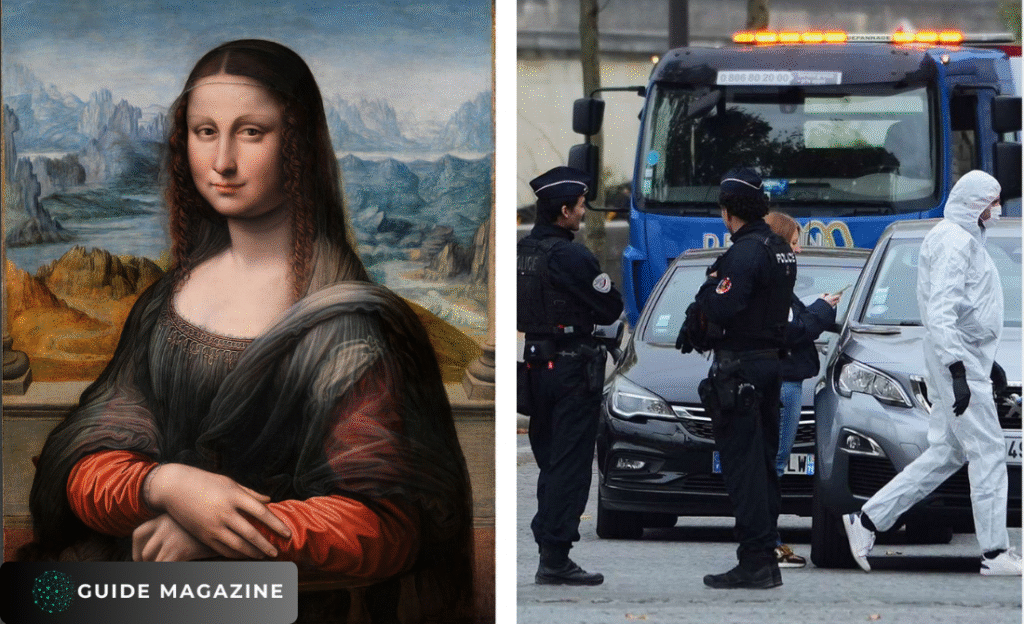
At the heart of the Louvre robbery was the Mona Lisa, painted by Leonardo da Vinci between around 1503 and 1519. This small portrait — just 77 cm by 53 cm — depicts Lisa Gherardini, a Florentine merchant’s wife, with her subtle, knowing smile and piercing gaze that seems to follow you around the room. Da Vinci’s use of sfumato, a technique blending colours softly without harsh lines, gives her an almost lifelike mystery that’s captivated viewers for centuries.
Before the theft, the Mona Lisa was respected among art experts but not yet the global superstar it is today. Many visitors preferred flashier works like Venus de Milo or massive history paintings. Acquired by King Francis I of France after da Vinci’s death, it had been in French hands ever since — legitimately purchased, though some Italians disagreed. Its value in 1911 was estimated at around 5 million francs (equivalent to hundreds of millions today), but its cultural worth was priceless. Little did anyone know, the Louvre robbery would catapult it to unparalleled fame.
The Day of the Theft: A Shockingly Simple Plan
The Louvre robbery unfolded on Monday, 21 August 1911 — a day when the museum was closed for cleaning. Vincenzo Peruggia, an Italian house painter who had previously worked at the Louvre installing protective glass cases, entered the building dressed in a worker’s smock. He knew the routines well and blended in perfectly.
Here’s how the theft happened, step by step:
- Peruggia waited until the Salon Carré (where the Mona Lisa hung) was empty.
- He simply lifted the painting off its four pegs on the wall.
- In a nearby staircase, he removed it from its frame and protective case, discarding the heavy wood.
- He tucked the panel under his smock and walked calmly out a side door.
- No alarms rang; no guards stopped him. The whole operation took minutes.
By Tuesday morning, when a photographer arrived to capture the painting and noticed the empty spot, panic set in. The Louvre was closed for a week, and police swarmed the scene. The abandoned frame was later found in a stairwell, but the painting had vanished.
The theft of the Mona Lisa from the Louvre Museum in 1911: here’s …
The infamous empty wall in the Salon Carré, showing the four hooks where the Mona Lisa once hung.
Discovery and Global Outrage
News of the Louvre robbery exploded across headlines worldwide. French newspapers decried it as a national humiliation; crowds gathered outside the museum to stare at the blank space. Attendance actually surged — people came just to see where the masterpiece had been.
The Theft That Made The ‘Mona Lisa’ A Masterpiece | KUNC
A typical 1911 newspaper headline capturing the shock and mystery surrounding the stolen Mona Lisa.
Rewards totalling over 50,000 francs were offered. Theories abounded: Was it an inside job? A prank? International intrigue?
Who Was Behind the Louvre Robbery?
The man responsible was Vincenzo Peruggia, a 29-year-old Italian immigrant living in Paris. Born in Dumenza, Italy, he was a skilled glazier and carpenter who had helped encase Louvre paintings in glass — ironically making him familiar with the Mona Lisa’s setup.
Peruggia’s motive was patriotic, not financial. He believed Napoleon had looted the painting from Italy during his campaigns (a common misconception). In reality, da Vinci had brought it to France himself, selling it to the king. Peruggia wanted to “return” it to its “homeland.” After the theft, he hid the Mona Lisa in his small Paris apartment, under a false bottom in a trunk, for over two years.
The Investigation: Suspects, Scandals, and Dead Ends
The police investigation was chaotic and often misguided. They fingerprinted everyone who had visited recently and even drained part of the Seine searching for the painting. High-profile suspects included poet Guillaume Apollinaire and his friend Pablo Picasso, who had once bought stolen Iberian statues from a shady source. Both were arrested and questioned, causing a media frenzy, but released for lack of evidence.
Borders were closed, and ports watched. Yet Peruggia, living quietly in Paris, evaded detection. The case grew cold until December 1913, when he contacted an art dealer in Florence, offering to sell the “original” Mona Lisa.
Recovery and Return

The dealer, Alfredo Geri, alerted authorities. When Peruggia arrived with the painting wrapped in red silk, he was arrested in his hotel room. Experts confirmed its authenticity by examining da Vinci’s characteristic cracks and brushwork. The Mona Lisa toured Italy briefly to huge crowds before returning triumphantly to the Louvre in January 1914.
Peruggia was tried in Italy, where public sympathy for his “patriotic” act led to a light sentence: initially one year, reduced to seven months. He later served in World War I and lived quietly until his death in 1925.
Aftermath: How the Theft Changed Museum Security
The Louvre robbery exposed shocking vulnerabilities. Museums worldwide tightened measures:
- Better surveillance and guard patrols
- Protective glass cases for valuable works
- Inventory checks and alarms
- Restricted access for workers
Today, the Mona Lisa sits in a climate-controlled, bulletproof glass enclosure, with guards and barriers keeping crowds at bay.
The Lasting Legacy of the 1911 Louvre Robbery
Paradoxically, the theft made the Mona Lisa the most recognised painting on earth. Reproductions flooded popular culture; its fame skyrocketed. Art experts note that without the robbery, it might remain just another Renaissance portrait. The incident also highlighted art’s vulnerability, influencing recovery efforts for looted works in later wars and inspiring countless books, films, and theories.
FAQs
1. Who stole the Mona Lisa?
Vincenzo Peruggia, an Italian Louvre worker, stole it believing he was returning it to Italy (though it was legitimately in France).
2. How was the theft carried out?
On a closed Monday in August 1911, Peruggia simply lifted the painting off the wall, removed the frame, hid it under his smock, and walked out—no alarms or guards stopped him.
3. Was the Mona Lisa recovered?
Yes, in December 1913 in Florence after Peruggia tried to sell it. It toured Italy briefly, then returned to the Louvre in 1914. Peruggia served only seven months in prison.
Conclusion
The 1911 Louvre robbery, carried out by a single determined man with no sophisticated tools, forever changed the fate of the Mona Lisa. What began as a quiet act of misplaced patriotism turned a respected Renaissance portrait into the world’s most recognised work of art. The theft exposed the vulnerability of cultural treasures and forced museums everywhere to rethink security.
