

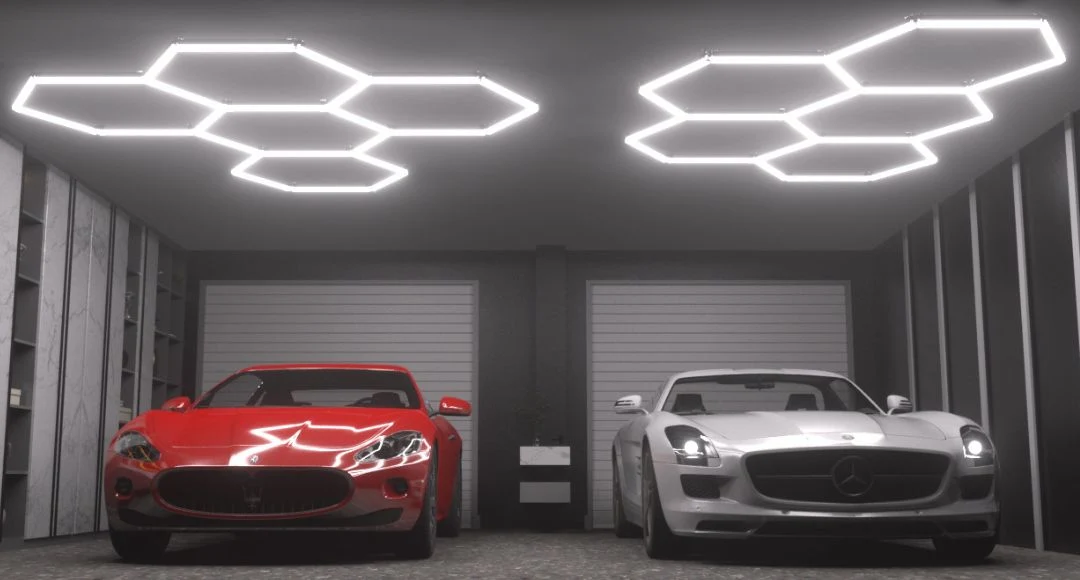
The answer is not always to install the brightest available fitting. Visual comfort and useful coverage depend on how light reaches the task, whether moving equipment blocks it and how the eye adjusts between indoors and outdoors. A seasonal check can identify failed products, dirty diffusers and badly placed fittings before the longest nights arrive.
Winter preparation should start above the work area
Vehicle work combines large reflective surfaces with narrow spaces beneath bonnets and around wheels. One central source can create glare on paintwork while leaving mechanical components in shade. Lift positions, benches and diagnostic stations each need to be viewed as working zones. The doors and pedestrian routes between them also require enough illumination for safe movement.
Choosing Garage lights is easier when the room has first been mapped by activity. LED battens can provide broad general illumination, while additional task lights may be needed for close work. LightHub Direct lists garage-suitable options in different lengths, outputs and protective ratings, allowing the proposed arrangement to be matched more closely to the site.
Cleaning can recover light without increasing energy use
Dust, exhaust residue and workshop debris build up gradually on diffusers. Staff may become accustomed to the resulting drop in output because it happens slowly. Cleaning fittings in accordance with the manufacturer’s guidance can restore useful light, although the electrical supply must be isolated where required and damaged enclosures should not be opened casually.
Pale ceilings and walls also help distribute light, while dark or heavily stained surfaces absorb more of it. A refurbishment does not have to begin with electrical replacement. Cleaning the room and checking reflectance can reveal whether the existing design is fundamentally weak or simply poorly maintained.
Flicker and colour quality affect inspection work
Visible flicker is distracting, but some poorly performing equipment can produce effects that are less obvious and still uncomfortable. Drivers and control gear should be suitable for the application, especially where lights run for long shifts. Reputable product information and correct installation are more useful than choosing solely by a headline wattage.
Colour rendering deserves attention in paint correction, detailing and fault finding. Technicians need to distinguish stains, wire colours and surface defects. A high-quality fixed light does not remove the need for an inspection lamp, but it gives staff a consistent visual base across the bay. Mixing very different colour temperatures can make comparisons harder and give the workshop an uneven appearance.
Sensors need to recognise real workshop behaviour
Occupancy controls can reduce hours of unnecessary use in stores, toilets and circulation zones. A working bay requires more care because a technician may remain within a small area or underneath a raised vehicle. If a sensor repeatedly switches the lights off, staff are likely to override it or regard the control as a nuisance.
Detection pattern, mounting height, delay time and manual control should be decided around actual behaviour. Corridor-style dimming may suit some commercial layouts by keeping a lower background level until movement is detected. The best control strategy is usually zoned, because a parts store and an active repair bay do not follow the same pattern.
Cold, damp and impact risk influence specification
Not every garage is a clean internal room. Roller doors introduce cold air and wind-driven rain, washing areas generate moisture and busy workshops create dust. Fittings should have an enclosure rating suited to their position, and seals must remain intact after installation. Products installed where equipment may strike them can also require suitable impact resistance.
Emergency provision needs separate consideration in workplaces. Normal garage lighting and emergency escape lighting perform different functions, even when an emergency option is integrated into a familiar batten. A competent design should address escape routes, exits and open areas rather than assuming that one battery-backed fitting covers an entire unit.
A lighting survey can support maintenance budgeting
An autumn survey should record the location, type and condition of fittings, together with obvious dark areas and staff feedback. Operating hours and electricity consumption can then be compared with replacement options. This produces a more credible budget than replacing failed lamps one at a time without considering the overall layout.
