

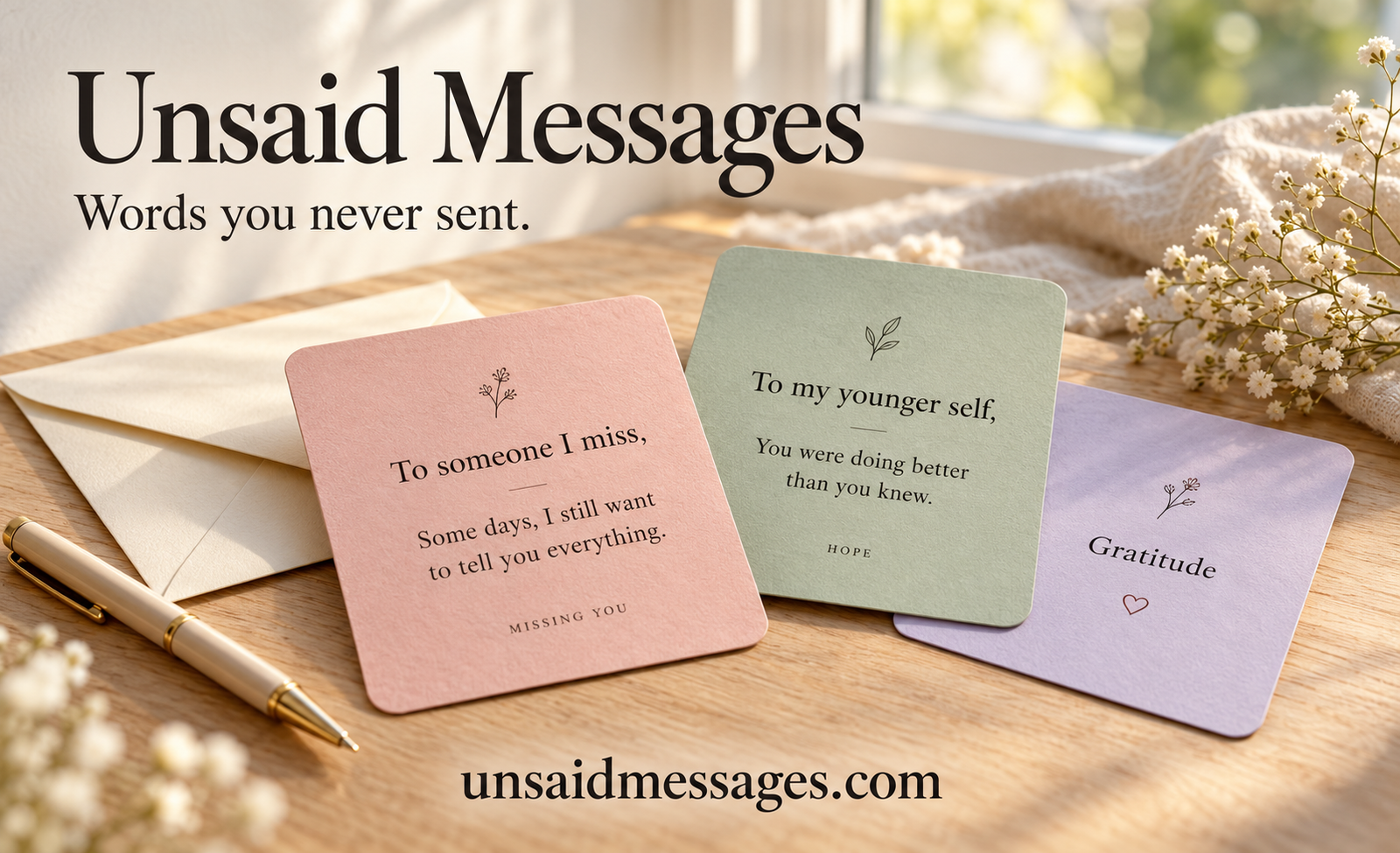
Unsaid Messages is a website where you can write words you never said, explore anonymous messages, and choose whether to submit your writing for public review or keep it private. Available at unsaidmessages.com, it brings together messages about love, friendship, gratitude, regret, loss, and hope. Messages are not delivered to the person named.
Perhaps you still remember a friend you stopped calling. Maybe there is someone you never properly thanked, or an apology you have rewritten in your mind for years. Sometimes, the words are meant for an earlier version of yourself.
Unsaid Messages gives those thoughts somewhere to go. You can begin with a few honest sentences, read something that feels familiar, or simply take your time deciding what you want to say.
What Are Unsaid Messages?
Unsaid messages are thoughts or feelings you wanted to express but never shared with the intended person. They might remain in an unfinished letter, a deleted text, an old notebook, or your memory.
They are not always sad. An unspoken message can hold appreciation, forgiveness, affection, or excitement about the future.
Common examples include:
- A thank-you to someone whose kindness mattered.
- An apology to a friend after a misunderstanding.
- A goodbye following the end of a relationship.
- A message to a loved one you miss.
- Encouragement for your future self.
- Feelings you understand better now than you did before.
At Unsaid Messages, these different experiences have room to sit beside one another. You do not need a dramatic story or a perfect ending to contribute.
What Is UnsaidMessages.com?
Unsaid Messages is a space for anonymous emotional writing and discovery. The website presents itself as “A space for your words,” with a focus on the things people never sent, never said, or still carry.
You can address a message to a first name or nickname, select the feeling behind it, and choose the relationship connected to your words. You can also select a colour and message language.
This makes each message more than an isolated paragraph. A note about gratitude to a parent has a different context from a goodbye to a former partner, even when both are short.
The purpose is personal expression. Writing a name does not contact that person, verify their identity, or establish that a message is about a particular individual.
What Can You Do on Unsaid Messages?
Write an Anonymous Message
The message-writing page lets you put your thoughts into words without displaying your identity to public readers.
The current form accepts messages between 20 and 2,000 characters. That leaves room for a brief confession, a meaningful thank-you, or a longer reflection without requiring an entire essay.
You can choose an emotion such as gratitude, love, hope, regret, grief, forgiveness, or closure. Relationship options include friends, partners, family members, mentors, and yourself.
Public submissions go through moderation before appearing on the website.
Explore Messages by Name or Feeling
Sometimes you arrive knowing exactly what you want to write. Other times, reading is the easier starting point.
You can explore public messages and search for a first name, a word, or a connection. The site also provides ways to browse by emotion, relationship, and language.
A familiar name may draw your attention, but it should not be treated as evidence that a message was written for you. Names serve as labels within the collection.
Reading with that understanding keeps the focus on the words and the experience they describe.
Discover Colourful Emotion Cards
Public messages appear on coloured cards that bring the recipient name, emotion, relationship, and writing together.
The presentation makes it easy to move between different kinds of feelings. You might encounter a hopeful note beside a message about missing someone, followed by a simple expression of gratitude.
If you would rather discover something without searching, the website’s Surprise Me option offers another way to explore.
Choose Private Writing
Not every thought needs a public audience.
The writing form includes a Keep Private option, with an account required for private writing. It also explains that a message ID and recovery code are needed to read the private message.
Before saving, check which visibility option you have selected and keep any recovery details somewhere you can find them again.
Leave Words for Another Day
The private time capsule feature offers a different kind of writing: words you create now and return to later.
Creating a capsule requires a private account. The site provides separate recovery credentials for retrieving it, and the capsule remains private after it opens. Its contents are not published or emailed.
You might use this space to record what matters to you today or write a note you would like your future self to read.
How to Write Your First Unsaid Message
You do not need to sound poetic. A clear, specific sentence often says more than an elaborate paragraph.
- Choose who the message is for. Use only a first name or nickname.
- Start with one thought. Focus on what you wish you had said.
- Add the feeling and connection. Select the emotion and relationship that fit.
- Choose a colour and language. Make the presentation feel right for your words.
- Decide between public and private. Public writing is submitted for review; private writing requires an account.
- Read it once before submitting. Remove identifying details and anything you do not want included.
If you feel stuck, try beginning with:
- “What I appreciated but never explained was…”
- “I understand now why that moment mattered…”
- “The thing I wish I had said before leaving was…”
- “When I think about that friendship, I remember…”
These are writing prompts, not rules. Your message can be gentle, uncertain, grateful, or unfinished.
A Space for Different Languages and Connections
Some feelings are easier to express in the language you use with family. Others come more naturally in the language of a particular friendship or memory.
Unsaid Messages offers message-language options for English, German, French, Spanish, Portuguese, and Urdu. Readers can browse by the language in which a message was written.
The range of relationship categories also matters. Unspoken feelings are not limited to romance. A teacher, sibling, colleague, stranger, or childhood friend can leave something worth putting into words.
You can also write to yourself. Sometimes the message you have been postponing is an acknowledgement of your own effort, a mistake you have learned from, or a hope you still want to keep.
Share Thoughtfully and Respect Other People
Unsaid Messages asks writers to leave out identifying information, explicit content, threats, and harassment. Public messages enter a moderation queue before they can appear.
Keep your writing centred on your own experience. Avoid including phone numbers, email addresses, home addresses, social handles, or details that could identify another person.
Anonymous publication still deserves care. A meaningful message can express hurt or disappointment without exposing someone’s private life.
You can read the website’s Community Guidelines before contributing.
FAQ’s
Q1. Does Unsaid Messages send my message to the person I name?
No. The website explicitly states that messages are not sent to the named person. A recipient name provides context for the writing.
Q2. Can I read messages without writing one?
Yes. You can browse public messages and explore the collection without submitting your own writing.
Q3. Will my public message appear immediately?
No. Public submissions are checked by a moderator before they can appear on the website.
Q4. Can I keep a message private?
Yes. The writing form offers a private option that requires an account. Follow the on-page instructions and retain the recovery details provided.
Q5. Is Unsaid Messages only for heartbreak?
No. It also includes gratitude, friendship, hope, joy, forgiveness, family connections, and other feelings.
Conclusion
You may never find the perfect moment to say everything. You can still give a thought your attention and decide how you want to express it.
Unsaid Messages offers several starting points: an anonymous public submission, a private message, a time capsule, or a few minutes spent reading other people’s words.
Visit Unsaid Messages to explore the collection or begin your own message. Start with one sentence you have been meaning to write.
