

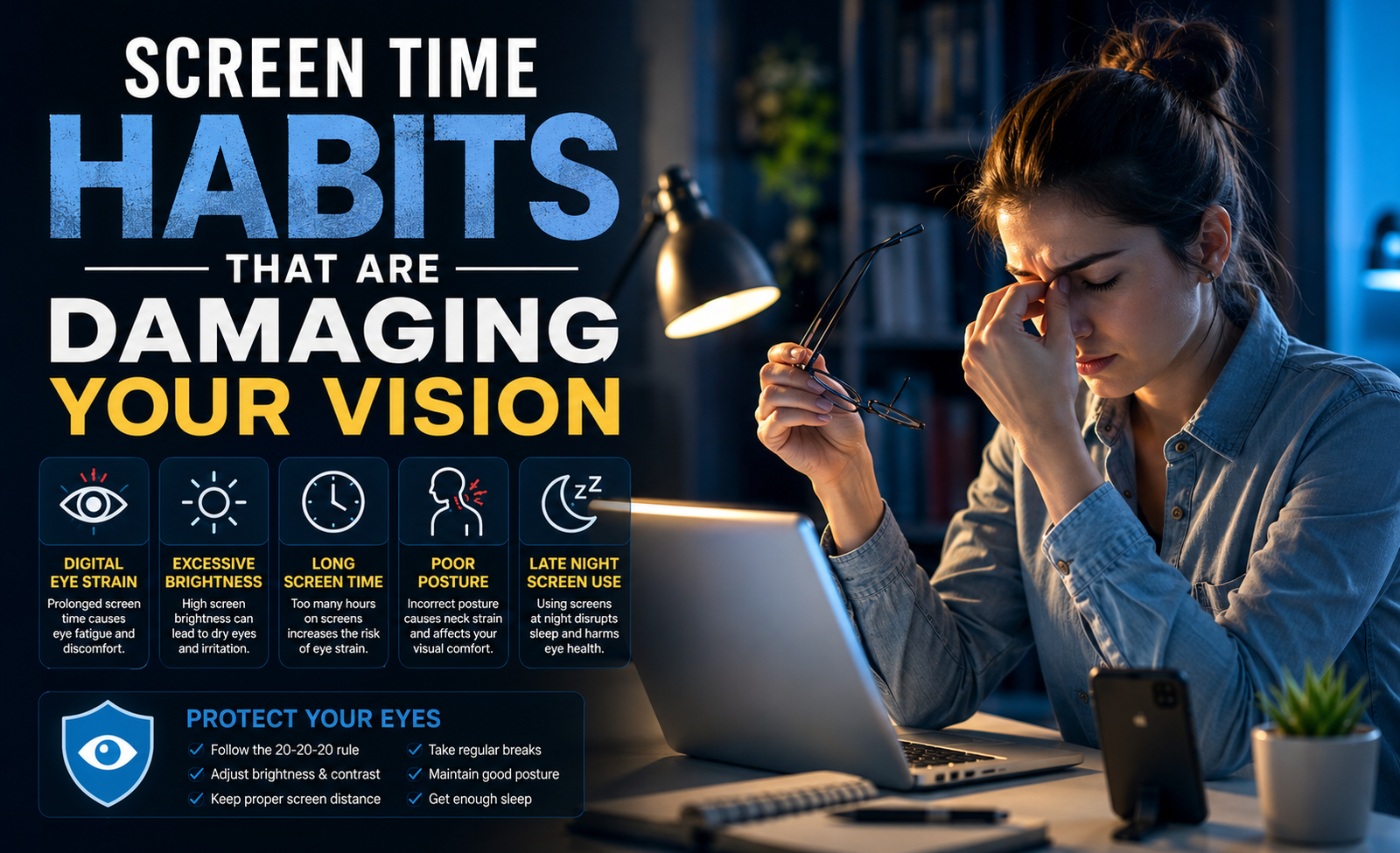
Nowadays, most individuals spend a significant portion of their day staring at screens. This occurs at work, while relaxing, and even prior to going to bed. It’s easy to overlook how detrimental this is to one’s eyes since the effects accumulate over a period of time. You may not notice a difference in a given day because of screen usage, but over weeks and months, the effects accumulate. You may feel that you are simply tired if the real reason you feel this way is too much time spent on screens. Below are the habits that result in such harm and how to alleviate the situation.
Why Screen Time Is Higher than Expected
How Much Time Do People Actually Spend on Screens?
Most people are shocked when they tally their daily screen time. Work done on a laptop, time spent on a phone, and watching TV or using tablets figure into the equation. After you take into account every short phone check and flash of scrolling, you likely discover the total screen time is much longer than expected.
Why Looking at Screens Causes Eye Strain
When staring at a screen, people blink less frequently than they normally do during other activities. As a result, the eyes do not receive proper hydration throughout the day. Moreover, using a screen causes the eyes to focus on a single point for a prolonged amount of time. Very few activities of the day force the eyes to focus on something for such a long period of time because even reading a book requires the person to constantly shift their gaze. Human eyes can adapt to focusing on various distances. Unfortunately, using a screen limits this ability greatly by keeping the gaze fixed on one spot for hours.
Checking Phones Right Before Sleeping
Using a phone late at night combines eye stress with bad sleep, as both issues worsen together rather than remaining separate. The bright light from the screen in a dark room makes the eyes work hard in terms of contrast as they have to adjust quickly.
Using Multiple Screens Simultaneously
Switching between a phone, laptop, and TV at the same time has become something normal in everyday life either at work or during free time, which may mean that one can check the phone while watching TV or look at two screens at the same time when performing a task. The more screens to focus on, the more the eyes suffer because they keep switching between objects that are at different distances, which makes it necessary to adjust constantly, thus adding effort.
Very Long Gaming or Watching Sessions
Spending a lot of time gaming or watching something makes the eyes work hard and become strained as there are very few breaks, especially when hours go by without any blinking.
Skipping Breaks at Work
Skipping breaks between meetings or tasks during a screen-heavy workday is a common habit. This is especially true for people with back-to-back video calls or long stretches of document work. Screen time without breaks builds up fast, even if each single task feels fine on its own. The strain from one task carries straight into the next, with no time for the eyes to rest in between.
Holding Small Screens Too Close
People often hold a phone closer to their face than they would hold a laptop or sit from a TV, especially during long scrolling sessions or while lying down. This shorter distance adds extra strain compared to a screen held farther away, even for the same amount of time. Small text on a phone screen also makes people hold it closer, which adds to the problem.
The Warning Signs Most People Ignore
The Signs You Notice Right Away
Headaches, blurry vision, and tired eyes by the end of the day often get blamed on general tiredness rather than screen use. This happens because a busy day gives plenty of other reasons to feel worn out by the evening. These signs show up in a predictable way after a screen-heavy day, but they rarely lead to any real change in habits, since people don’t always connect the screen time to the discomfort.
The Signs That Build Up Slowly
Dry, gritty-feeling eyes from less blinking during long screen use often go unnoticed until they happen often. At that point, they start to feel normal instead of something worth fixing. Trouble focusing on things far away right after a long stretch of close screen work is another sign that people often miss. It usually fixes itself within a few minutes, so it rarely gets linked back to the screen time that caused it.
How the Problem Grows Over Time
Some people notice a slow change rather than a sudden one. Their eyes may feel tired earlier in the day than before, or discomfort may last longer after screen use than it used to. This slow change makes it easy to just accept it, instead of finding the real cause. Each day feels only slightly different from the last, so the full change only becomes clear when you compare how things feel now to how they felt months or years ago.
What Actually Helps
Getting the Right Vision Correction
Comfortable contact lens options or glasses made for screen use play an important part in managing eye strain from long screen-heavy days. This matters most for people whose daily routine involves hours of steady, close-range focus. An old prescription can make screen-related strain worse than it needs to be. This happens because the eyes have to work harder to make up for a correction that no longer matches your actual needs, adding extra effort on top of the strain screens already cause.
The Rule of 20-20-20
This very straightforward yet famous practice dictates that you must glance at something approximately 20 feet away for 20 seconds after every 20 minutes of phone or computer usage, letting your eyes take a quick break from the constant focus of the screen. Being consistent with it will always be more productive than being perfect at it. To benefit the most from this approach, you must adopt it as a regular practice rather than as a remedy for eye discomfort.
Changing Your Computer and Setting
The brightness of your computer, the blue light filter, and the distance from the screen can be adjusted with little effort and with a considerable reduction of eye fatigue. Nowadays, almost all devices let you make those alterations without knowing anything about computers. If you are working next to the window or beneath a bright lamp, the reduction of glare will prevent your eyes from becoming unnecessarily tired, regardless of the quality of your screen.
Building Screen-Free Time Into Your Day
Setting aside short periods with no screen at all, even just during a meal or a short walk, gives your eyes a real break. This is different from simply looking away from one screen toward another. These breaks add up over a full day in a way that quick micro-breaks alone cannot match, since a full break away from all screens lets your eyes properly rest.
When to See an Optician
Signs That Indicate Something Isn’t Quite Right
Trying to cope with issues that remain constant despite various changes might call for something far more serious than mere guessing. That’s especially true if the problem persists for weeks with little noticeable improvement after trying the fixes indicated previously. Moreover, when changes in one’s vision can be linked to increased screen use, they should also be reported to the practitioner during their visit. These may indicate that the patient needs to get a new prescription rather than simply developing a new screen-related habit.
Importance of Regular Check-Ups
It really matters to detect a prescription change before it leads to the never-ending discomfort with screens. That’s because what was once the perfect prescription might become quite unsuitable at some point in time without any clear sign of the change occurring. Regular visits made on a consistent basis rather than only when something goes wrong might significantly help with detecting minor issues early before they become a significant causes of discomfort in the long-term.
What to Tell Your Optician
Mentioning specific screen habits during an eye test, such as long hours at a computer or regular gaming, helps your optician know exactly what to check and what advice to give. This detail often gets left out of a normal appointment, even though it can change the advice quite a bit. An optician who knows your full screen habits can give far more useful guidance than one working from generic questions alone.
Conclusion
Screen time doesn’t seem to be disappearing anytime soon, and for the vast majority, giving it up entirely is not a viable option given how much work, communicating, and entertainment now utilizes it. Instead of attempting to overhaul the entire regimen, it is better to develop a few simple habits that can be carried out regularly. Having a short break every twenty minutes, adjusting the screen brightness at night, unplugging from all devices at least for a little while during the day, and making sure the eye glasses are suitable for the current condition are all more effective when being used together than any one of them alone.
None of this means that you should stop your regular habits of using screens in your life, be it for gaming, working, or scrolling through various materials during the evening time. It means that the only thing you should do is be aware of the influence of these habits on your vision over time and learn to take the right steps to relieve the strain that is building up before it becomes a big problem. An eye examination is one of the easiest means of getting ahead of the changes, making it possible to detect the change in the prescription or the strain before it has turned into a serious issue. Safeguarding one’s eyesight in the modern world is based on constant habits rather than any one-off solutions, and the earlier one adopts the necessary habits, the less effort they will need to make it up later.
