


In the modern digital economy, data has become a strategic asset. Financial transactions, customer databases, ERP systems, SaaS platforms, analytics, intellectual property – all of this exists in digital form. Data loss today is not merely a technical issue, but a direct financial risk, a reputational threat, and a potential legal consequence.
This is especially relevant for companies hosting infrastructure in European data centers, including Frankfurt am Main – the largest digital hub in Europe. Banks, fintech platforms, SaaS providers, iGaming operators, and multinational corporations are concentrated here. Any incident involving data loss requires an immediate response.
That is why data recovery services have become part of a company’s infrastructure strategy alongside backup and disaster recovery services.
What are data recovery services
Data recovery services are a set of technical and engineering procedures aimed at restoring information from damaged, deleted, or inaccessible data storage media.
This may involve:
- hard disk drives (HDD)
- SSD storage devices
- RAID arrays
- NAS systems
- server storage systems
- virtual environments
- cloud infrastructures
It is important to understand that data recovery is not the same as restoring from a regular backup. If no backup exists, if it is corrupted, or if the incident has affected the storage system itself, data recovery specialists are required.
In a corporate environment, recovery services may be needed in cases such as:
- hardware failure
- logical file system errors
- RAID corruption
- accidental deletion of critical data
- virus attacks and ransomware
- virtualization failures
- power outages causing storage damage
Next, we will examine how the data recovery process works in practice and what stages it consists of.
How the data recovery process works
Data recovery services follow a strict engineering methodology. It is not an attempt to simply “read a disk,” but a controlled technological process designed to extract the maximum amount of information without worsening the damage. The process typically includes several stages.
Initial diagnostics
The first step is a technical assessment of the condition of the storage medium or system. Specialists determine the type of damage: physical (mechanical or electronic), logical (file system corruption), or complex.
In a corporate environment, diagnostics are often performed with consideration of the infrastructure architecture: whether RAID, virtualization, SAN, or distributed storage is in use. At this stage, it is critical not to power on the device unnecessarily, as this may further damage disk surfaces or memory cells.
As a result of the diagnostics, a technical report is prepared, including:
- the nature of the damage
- the estimated amount of recoverable data
- associated risks
- approximate timelines
Creating an exact copy of the storage medium
A key principle of professional recovery is never to work directly with the original device. Specialists create a bit-by-bit copy (disk image) using specialized equipment capable of reading data even from partially damaged surfaces.
In the case of RAID or server systems, the array configuration is documented first: disk order, RAID level, and controller parameters. An error at this stage may result in complete loss of the data structure.
In a data center environment, especially in locations such as Frankfurt, copying can be performed directly in the rack with the support of a Remote Hands team to minimize downtime.

Logical reconstruction of the data structure
After creating the image, specialists analyze the file system: NTFS, EXT, XFS, ZFS, and others. File allocation tables, directories, and metadata are reconstructed.
If RAID logic is corrupted, the array is rebuilt in a virtual environment. This allows data to be “reassembled” without physical intervention in the hardware.
Data extraction and verification
At the final stage, specific files or data sets are extracted. Their integrity is verified, and if necessary, partial reconstruction of damaged blocks is performed.
For businesses, it is particularly critical to recover:
- databases
- virtual machines
- accounting and ERP systems
- client CRM systems
- mail servers
The recovered data is delivered to the client on a new storage device or via a secure data transfer channel.
Technologies used in data recovery
Professional data recovery relies on specialized technologies.
Clean rooms
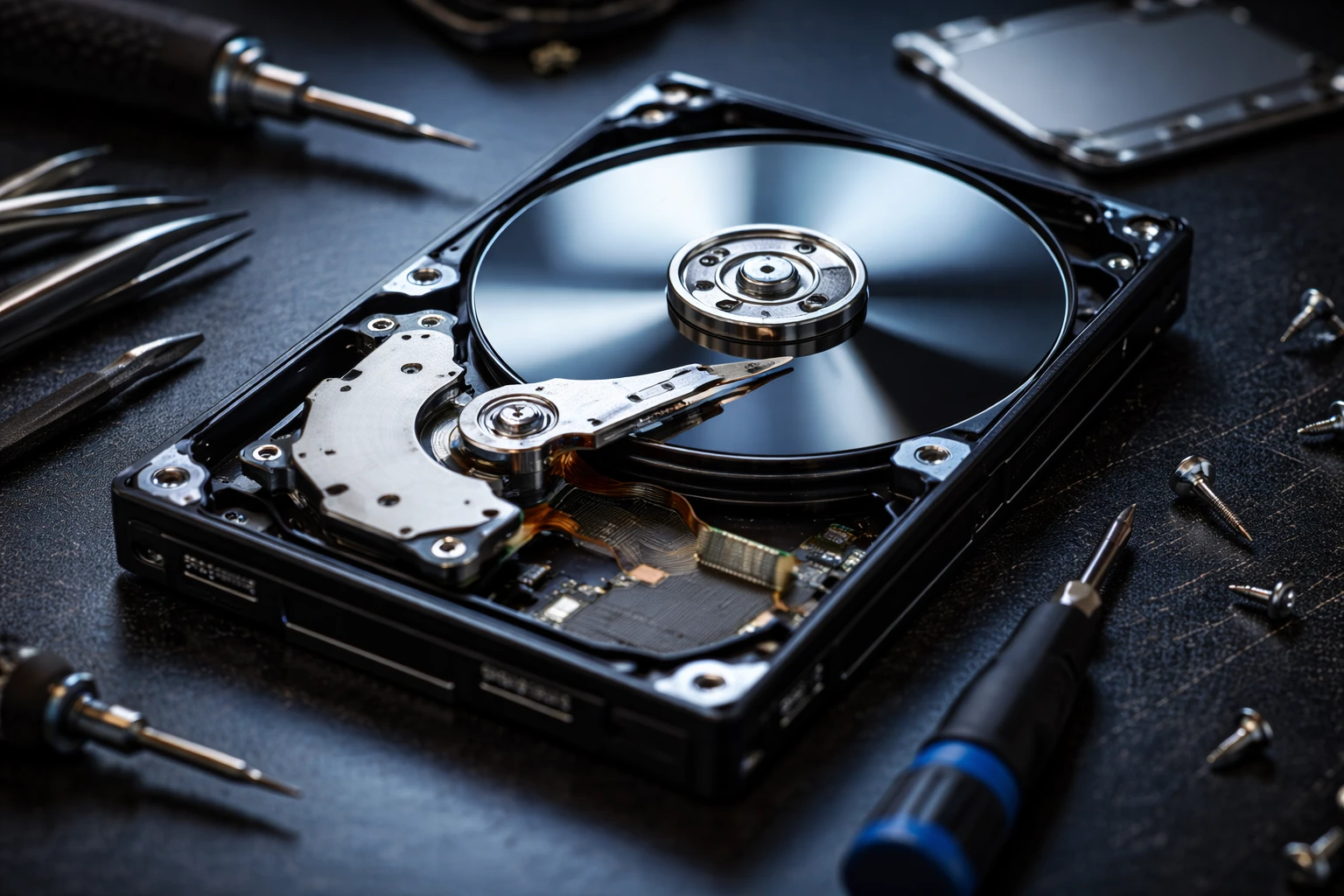
In cases of physical HDD damage, opening the drive is only possible in an ISO-class sterile clean room environment to prevent microscopic particles from damaging the platter surface. Any intervention outside a clean room almost guarantees permanent data destruction.
Low-level hardware reading systems
Professional systems are used that can:
- read data sector by sector
- bypass bad blocks
- control spindle speed
- operate with damaged firmware
For SSDs, separate methods are applied, including direct NAND chip reading and controller-level reconstruction.
Software reconstruction tools
In cases of logical damage, specialized algorithms are used for:
- file table recovery
- RAID reconstruction
- file signature analysis
- virtual disk recovery (VMDK, VHD, etc.)
In corporate environments, recovery increasingly involves virtualized infrastructure, requiring analysis of hypervisors and storage systems.
Next, we will examine the differences between laboratory and remote recovery, as well as specific considerations when working within a data center infrastructure.
Laboratory and remote data recovery
The service format depends on the nature of the incident and the architecture of the infrastructure. In a B2B environment, this is critical, as downtime can cost a company tens of thousands of euros per hour.
Laboratory recovery
This format is used in cases of physical media damage: mechanical wear, HDD head failure, electronic board damage, short circuits, fire damage, or flooding.
In such cases, the storage device is removed and sent to a specialized laboratory. Work is carried out in a clean room using professional equipment. Possible procedures include:
- replacement of the magnetic head assembly
- repair of the controller board
- firmware restoration
- direct NAND chip reading
Laboratory recovery is the most complex and expensive scenario, but in some cases it is the only way to restore mission-critical data.
Remote recovery
If the damage is logical in nature – for example, accidental deletion, file system corruption, or virtual machine failure – recovery can be performed remotely.
Specialists connect to the infrastructure via secure channels, create disk images, analyze the data structure, and perform reconstruction without physically removing the equipment.
For companies hosting servers in European data centers, including Frankfurt, this approach allows them to:
- avoid equipment transportation
- minimize downtime
- maintain compliance with security requirements and GDPR
- accelerate decision-making processes
Data recovery in corporate infrastructure and data centers
In a corporate environment, incidents rarely involve a single disk. More often, they affect complex systems such as:
- RAID arrays
- SAN or NAS systems
- Hypervisors
- virtualization clusters
- distributed storage systems
RAID recovery is particularly complex. If one disk fails, the system may continue operating. However, if a second disk fails or the array is incorrectly reinitialized, the data structure may be destroyed.
In a data center, the recovery process differs from an office environment. It is critical to:
- preserve the array configuration
- document the disk order
- prevent automatic RAID rebuild
- shut down the system properly
In infrastructure hubs such as Frankfurt am Main, data centers typically provide Remote Hands services. This makes it possible to quickly:
- remove disks
- document the configuration
- create disk images
- prepare the system for recovery
However, it is important to understand that the data center provider is responsible for infrastructure (power, cooling, network), not for the contents of the servers. Responsibility for the data remains with the equipment owner.
Risks and limitations of recovery
Despite advanced technologies, data recovery does not always guarantee a 100% result.
Key limitations include:
- multiple overwrites of data
- physical destruction of disk platters
- NAND memory degradation
- damage to encrypted volumes without the encryption key
- incorrect self-attempts at recovery
Attempts at “self-repair,” especially in corporate RAID systems, are particularly risky. Rebuilding an array without understanding its parameters often makes subsequent professional recovery significantly more difficult.
In addition, time is a critical factor for businesses. The longer a system continues operating in a degraded state, the higher the risk of complete data loss.
In the next section, we will examine how to choose a data recovery services provider and why recovery should be part of a business resilience strategy rather than an emergency measure.
How to choose a data recovery services provider
For the B2B segment, selecting a data recovery contractor is not only a technical issue, but also a matter of risk management. A wrong choice may lead to complete data loss, exposure of confidential information, and legal consequences.
The first factor to consider is whether the provider operates its own laboratory. If storage media are transferred to third parties, the chain of custody becomes more complex. For companies processing personal data of EU citizens, this is also a matter of GDPR compliance.
The second factor is experience with corporate infrastructure. Recovering data from a single laptop and reconstructing a RAID 6 array in a server rack require entirely different levels of expertise. The provider must understand:
virtualization architecture
- SAN and NAS principles
- server-grade SSD specifics
- interaction with hypervisors
The third aspect is process transparency. The client should receive a technical assessment, understand the estimated recoverable data volume, and be aware of the risks before work begins.
Additional important criteria include:
- SLA availability
- initial diagnostics timelines
- confidentiality terms
- capability to work with encrypted systems
- secure delivery of recovered data
For companies hosting equipment in Frankfurt or other European hubs, an additional advantage is the provider’s ability to coordinate efficiently with the data center and Remote Hands teams.
Data recovery as part of a business resilience strategy
Data recovery services represent a high-technology process based on engineering diagnostics, precise disk imaging, and structured data reconstruction. In corporate environments, especially in European data centers and hubs such as Frankfurt am Main, recovery requires consideration of infrastructure architecture, virtualization layers, and security requirements.
The faster a company responds to an incident and the more professionally the contractor is selected, the higher the probability of restoring mission-critical information.
In the next step, we can proceed with adapting the article for a European B2B audience, if needed.
